
Photo by Melissa Cassar on Unsplash
One Woman’s Story of Living – and Dying – with Bulbar Onset ALS
By Fran Johns
(Reprinted from her substack ‘The Optimistic Eye’)
A little more than two years ago my friend Lynne Calkins pronounced her own death sentence. One of the founders of End of Life Choices CA, a nonprofit that provides free support to Californians navigating end-of-life decisions, she was speaking with a man who had called seeking help. When she hung up the phone she said to herself, “He sounds just like I’m beginning to sound.”
He had Bulbar onset ALS.
Doctors had been sending Lynne, a retired Nurse Practitioner, to a variety of specialists in efforts to solve her growing problems with speech. The good news was that she had made the correct diagnosis, so it was now possible to confront her disease. The bad news was that the diagnosis was Bulbar onset ALS, a rare and ultimately fatal disease for which there is no treatment and no cure.
Amyotrophic lateral sclerosis (ALS) is commonly known as Lou Gehrig’s Disease. About three quarters of all cases are limb-onset, affecting the arms and legs first. The rarer form takes its name from the “bulbar” region of the brain, which controls the muscles in the face and neck and processes like swallowing and speech.
In other words, no fun. Early on, Lynne found her slurred speech meant she was treated dismissively (or worse) by sales clerks and others who assumed she was either drunk or mentally disturbed. Eventually she lost the ability to make herself understood at all. Try absolutely muting yourself around everyone you love and enjoy, perhaps a beloved husband of more than six decades, and see how that works out.
There are a few upsides to Bulbar v limb-onset ALS — Lynne was still playing tennis several months ago — but for the most part it is a bewildering journey none of us would choose.
It’s been my joy to share that journey with Lynne, tracking major road bumps like loss of the ability to swallow, and detours, anticipated or unexpected: mood swings, exhaustion, frustration, isolation . . . recently she encountered jaw-breaking yawns until a wise hospice nurse suggested ways of dealing with that new weirdness.
A wry humor probably helps. Thanks to weight loss common to those with the disease — Lynne hovers around 85 pounds — and wrinkling of skin, she muses that towards life’s end “We Bulbar people may resemble each other more than our families.” And in another post a day or two ago I quoted her describing her G-tube meals as “One-third Mad Chemist as I mix my formulas in their bottles/bags; One-third Drug Addict, preparing my fix to “inject,” into my body; and One-third Nursing Mother as I lift my shirt…”
We have been logging notes of the funny moments, the frustrations and the weirdnesses in hopes of furthering understanding of this awful disease. (EOLCCA will eventually make available a compilation of it all.)
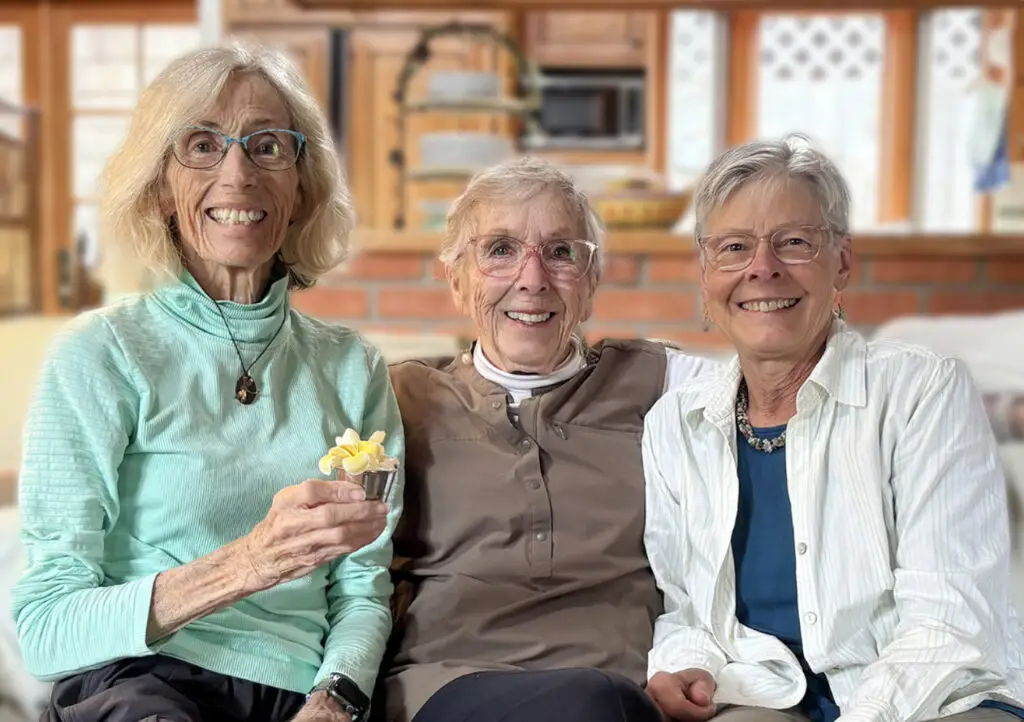
Bulbar onset ALS offers a projected life expectancy of two to three years, less among “older people.” I strongly suspect that on hearing that prognosis I would simply get in bed and pull the covers over my head. Not so, Lynne Calkins. She continues to work with EOLCCA, quite recently still training volunteers, working on programs and attending board meetings — eventually through texting with an interpreter.
Full disclosure and a warning: I’m lucky to serve as a volunteer and fellow board member of the excellent nonprofit mentioned above and below. If you know anything of nonprofits, you know they’re always interested in donations and that’s involved in what’s ahead:
Yesterday, Lynne sent a letter to friends and family that included these lines:
“My Bulbar-onset ALS is relentlessly progressing, and I know my time is short, but for right now, I’m still enjoying life and having fun! Although I can no longer speak nor swallow, and I tire easily, I’m very, very happy to still be here, very much alive, enjoying my home and family and you.”
The letter was prompted by several milestones: First was the recent 66th anniversary of her marriage to Ken Calkins. “Woo Hoo! That’s an amazing length of time to be married to the SAME person and to keep those marriage vows, ‘For better, for worse…in sickness and in health…’ all those sixty-six years! He deservedly received a Medal of Valor for keeping those vows, especially now.” Second was her 85th birthday on July 13.
This space very rarely gets into finance. I don’t monetize my Substack (wisely; it could get embarrassing) though I do pay to subscribe some worthwhile writers. And if you’ve pledged money in following me, thanks, butI’ve no plans ever to activate that function. But I hereby invite you to consider a Milestone gift in honor of my friend Lynne. Here’s how, per yesterday’s letter:
“It is my fervent hope that my beloved nonprofit organization, End of Life Choices California (EOLCCA), founded in 2019, will go on for another 85 years, continuing to help more and more Californians with end-of-life planning. It will require continued funding to sustain the high level of information, education and bedside support we now offer.
“If you would like to help me celebrate my milestones with a gift of support to EOLCCA, please go to our website at endoflifechoicesca.org, and donate any amount you’re comfortable with: 85 cents or $85.00 or $66.00 or if you want to be a Lynne’s MILESTONE SUPERSTAR, $151.00 (Birthday and Anniversary milestones combined). Or mail a check to 153 S. Sierra Ave. #30, Solana Beach, CA 92075.”
I share Lynne’s enthusiasm for EOLCCA and the services its volunteers provide, so I’m already a supporter. But because I want to be a Milestone Superstar I just made an extra donation in her honor.
OK, back to counting my blessings now. Lynne Calkins is one.
____________________________________________________________
A lifelong newspaper and magazine writer, EOLCCA Board Member Fran Moreland Johns has published fiction, nonfiction, and several books. Her focus on end-of-life issues includes many volunteer years, numerous articles and one book, Dying Unafraid. She holds a BA from Randolph-Macon Woman’s College and an MFA from the University of San Francisco, and currently writes on Medium.com, franjohns.net, and on Substack at franmorelandjohns.