…If you know what to expect.
By Fran Johns
When my husband Bud died I knew a lot about what was happening. I had attended medically- aided deaths as a trained volunteer; I had been with friends and loved ones as they died. I’d seen extremely peaceful deaths brought about by VSED (Voluntary Stopping Eating and Drinking) or MAiD (Medical Aid in Dying) as well as more than a few extremely difficult deaths of young men with AIDS during the 1990s.
This was different – that goes without saying.
But the fact that I understood what was happening to Bud’s body, and the fact that he’d gotten the death he wanted (fast, at home) combined to leave me with a large dose of gratitude along with my grief. If knowledge is power, knowledge of the physiology of dying is also comfort. It’s in this spirit that I – a writer with an Art degree who barely squeaked through Human Biology – offer this personal window into the dying process.
That process began, for Bud, with one day of diminishing participation in life around him. A combination of accelerating COPD (chronic obstructive pulmonary disease) and atrial fibrillation (heart failure) had felled him the night before. I knew this because he said, late afternoon, that not only did he not want any dinner, he didn’t even want his nightly martini. A night without the martini was like an EMT alert.
“He didn’t even want his nightly martini. A night without the martini was like an EMT alert…“
This is often the earliest stage of the dying process: the body’s senses (taste, smell) have begun to diminish and interest in food and drink goes away. Some thanatologists – those who study death and dying – see this as a sort of “detachment from the world.” When I poured the martini down the drain, my own understanding of Bud’s beginning detachment was triggered. And this, I think, can be both comforting and useful for loved ones as someone dies.
The second day of Bud’s dying involved withdrawal of all food and medications. There was also a visit from an old friend who spent an hour or so at the bedside making irreverent fun of some of that day’s news (this being six years ago, when we were still laughing at the daily news.) That hour convinced me that laughter is both the best medicine and the best memory.
Within another 24 hours, Bud had slipped out of consciousness and into a semi-comatose state that would last for another day. This was another state I’d seen before. There is no defined time during which these things happen, but I knew that gradual slowing down and eventual cessation of breathing, heartbeat, and brain activity is the way the body dies – and that changes would occur such as a drop in temperature and changes in skin color and texture.
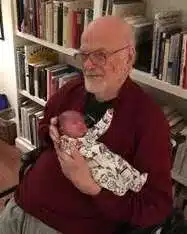
Bud and Sebastian
The last stage of the dying process, often called “active dying,” can last for a few hours or a few days. This is a period in which the dying person is essentially unconscious, as systems are shutting down.
One of the things often most difficult for loved ones to experience is the “death rattle” of the dying person’s breathing. It’s a change in breathing patterns called Cheyne-Stokes respiration, rapid breaths followed by long periods of no breathing at all. Mucus and saliva build up because they can’t be swallowed, which causes a gurgly sound. Like other bodily changes, this can be stressful for loved ones although it is not causing pain or anguish to the dying person.
During this period of time, beautiful moments often occur. Hallucinations of long-dead loved ones, sudden moments of clarity. Something said or done by the dying person as if there’d been a moment of wakefulness. A form of this happened at our house:
Bud and I have a close relationship with a couple whose first child, Sebastian, had been born eight weeks prematurely, several months before Bud’s death. The day he left the NICU (Neonatal Intensive Care Unit,) where I’d been a frequent visitor, his parents brought Sebastian over to meet Bud. A few weeks later they came back as he lay dying. His mom laid tiny Sebastian on Bud’s chest, prompting the last movement we saw him make when his right hand slowly raised as if to pat the newborn, ushering the 90-year-old into the hereafter.
Death is a mystery, and no two deaths are the same. But as theorized earlier, knowledge of death can bring power and comfort. Ask any EOLCCA volunteer; he or she will be happy to share their stories.
A lifelong newspaper and magazine writer, EOLCCA Board Member Fran Moreland Johns has published fiction, nonfiction, and several books. Her focus on end-of-life issues includes many volunteer years, numerous articles and one book, Dying Unafraid. She holds a BA from Randolph-Macon Woman’s College and an MFA from the University of San Francisco, and currently writes on Medium.com, franjohns.net, and on Substack at franmorelandjohns.