
Confronting the issue of dying with dignity, Medical Aid in Dying, and coming to terms with terminal illness and death has become more commonplace in film and television. A new entry arrived in theaters last November and is now streaming on Netflix.
The Room Next Door is a multilayered film about the demands and rewards of friendship, and the potential for love to promote healing and forgiveness. Integrated into these themes is the insistence of having “a good death”– one that is part of a life lived with intentionality. The film, written and directed by the Spanish director, Pedro Almodóvar (his first film in English), is based on Sigrid Nunez’s 2020 novel “What Are You Going Through,”
The storyline is fairly simple: Ingrid (played by Julianne Moore) and Martha (played by Tilda Swinton) are two old friends and co-workers, who are reunited when Ingrid finds out that Martha has advanced cancer. Martha decides to withdraw from experimental cancer treatment when she discovers that it’s not working. She asks two of her closest friends if they would “help her” end her life, and they refuse. Ingrid–after careful consideration–agrees to help her.
Martha has acquired “a euthanasia pill” on the dark web and has designed her exit plan. She finds a house to rent in the woods in Woodstock, NY, where she will take the pill. Ingrid will be in “the room next door.”
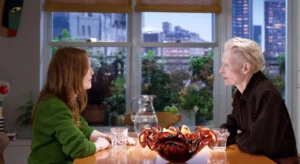
If Martha’s door is closed, it means she has ingested the pill. Martha gives Ingrid very detailed instructions about what to do when she finds her body so she is not implicated in the death.
The simplicity of the story is complemented by the stunning setting, photography, and music. As soon as Martha and Ingrid walk into the house (almost entirely made of glass), they open the window coverings and the rooms are filled with a radiant light. Once they settle into the house, Martha is able to relax and ease into her decision.
As someone deeply involved in this topic, I had an issue with several details (much like an attorney might have with some courtroom scenes!), such as the use of the term euthanasia, the suggestion that there is “one pill” that can effect the desired outcome, and that suicide is illegal. At End of Life Choices California, we work to shift these perspectives by using correct terminology and sticking to the facts.
There are also a couple scenes that happen at the very end that don’t seem entirely plausible to me, but I’ll hold off from describing them so I don’t spoil the ending.

My issues aside, the film is beautiful to watch and Moore and Swinton do an excellent job. The film is certainly a plea to legalize Medical Aid in Dying in New York (where the film takes place) and the other states where it isn’t legal. The film resonates with the message that all adults who are terminally ill, and have less than six months to live, deserve to choose the kind of death they want, when they want it.
If you or someone you care about is eligible and considering Medical Aid in Dying, you don’t have to go through it alone. You can request support here.
Have you seen the movie? What did you think? Share your comments below!
Author note: Stewart Florsheim serves on the Board of Directors of End of Life Choices California. He has been an activist and leader in the end-of-life choice movement in California since 2003. He was deeply involved in the effort to successfully pass the California End of Life Option Act in 2015. Stewart has given many presentations on end-of-life choice, including on radio and TV. Stewart is also a poet and non-fiction writer. You can find out more about his work on his website.