
Adrian wanted some answers
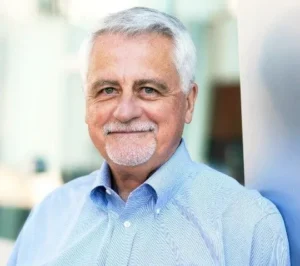
Byram, a neuroscientist and medical ethicist – and member of the EOLCCA Board of Directors – is not one to leave a complicated question unsolved. And this one defied understanding. Whether it was his data-driven mindset, his Canadian/American dual citizenship or his fierce commitment to personal autonomy, Byram saw the need to dig deep for the real facts.
The question? How could two very similar groups – the people of California and the people of Canada – differ so radically in their use of Medical Aid in Dying?
From Canada to California
Raised in Ottawa and Toronto, Canada, Byram attended grad school at Stanford then remained in California as an entrepreneur and executive in the IT industry. After retiring in 2012, he earned a PhD in neuroscience and medical ethics from the University of British Columbia. His thesis dealt with the issue of decision-making by surrogates for ICU patients – this being only the first medical/ethical question he would thoroughly address.
In these years, Byram also developed a deep interest in end-of-life choice. Though his father and father-in-law had both died young, his mother and mother-in-law lived into their 90s. “My mother-in-law had been very specific (that she wanted to avoid prolonged suffering) but then she did not have a choice. At the end she had palliative sedation; my wife and her sister were at least able to urge that she be given more morphine to limit her suffering.”
But those decisions, whether made by family or by physicians, are never easy, Byram explains.
I should have the choice
“My thesis had an entire chapter on the evolution of bioethics from its inception in the 1970s to today,” he says. “Bioethics has four principles : Respect for the patient’s autonomy; Do no harm; Try to be good; and Justice – which is very complicated.” Respect for autonomy, Byram says, is paramount to him in situations involving end-of-life decision-making: “I should have the choice of what happens to me.” It’s at the heart of his most recent study.
Study highlights lack of information
Don’t Californians want that choice about how their lives end? Byram couldn’t believe that’s not so. Californians (Byram and his wife have lived in the San Francisco Bay area for 40 years) are similar to Canadians in many ways, why would this be different?
Here’s what he and Reiner found:
(1) Only 25% of Californians know MAID is even available, let alone that it is their legal right, while 67% of Canadians know MAID is their legal right. And,
2) All Canadian healthcare institutions let everyone know MAID is available, along with all the other services they offer. In California, healthcare institutions commonly use their websites to list their many treatment and wellness services, but (with the exception of Kaiser Permanente) mention MAID, if at all, on hard-to-find pages.
Narrowing the gap
We can narrow that gap, and improve the life and death of Californians.
How? Every supporter of end-of-life choice is invited to spread the word and circulate the link (here) to the summary of the study to your friends and on your social media channels. You can also request a speaker to address your community group and–if you’re so inclined–to volunteer with us! We always appreciate donations to help us do the work we do–at no charge at all to our clients and their families.
And, most importantly, know that MAiD is available to you. You may never need it, but you have the right to understand it and choose it if the time comes.
A lifelong newspaper and magazine writer, EOLCCA Board Member Fran Moreland Johns has published fiction, nonfiction, and several books. Her focus on end-of-life issues includes many volunteer years, numerous articles and one book, Dying Unafraid. She holds a BA in Art from Randolph-Macon Woman’s College, and currently blogs at Medium.com and franjohns.net. Her short story collection, Marshallville Stories, was released in April 2022.
EOLCCA supports a strong team of experienced volunteers throughout the state, ready to help families with information and support to navigate their end-of-life planning and choices. That includes obtaining aid in dying through the California End of Life Option Act, helping them obtain needed services or adequate pain control, and finding physicians and hospices for them who are willing to prescribe MAiD. EOLCCA is a nonprofit organization and we rely on volunteers, as well as donations from individuals and foundations, to advance our work. To get involved, please visit ways to help. Thank you!
7 Responses
I want to have the choice to end my life when I reach a certain point that makes sense, medically and mentally.
This I have believed for years, and I’m thankful more details are becoming known.
A profound and frustrating question!!! I am more interested in what to do about it, ie, how to inform the public, than the “why” and would love to work with you on that. But let’s remember that our Supreme Court in 1997 voted 9-0 that assisted dying was NOT a constitutional right. They overturned the 9th and 5th circuit courts of appeal both of which declared in 1996 that it WAS a constitutional right. (And we had a GOOD court at that time.) The Canadian Supremes first voted 5-4 AGAINST allowing Sue Rodriguez an assisted death (?1998) but the changed to unanimity (2026?) agreeing that doctors could help
patients die (and not just terminally ill ones.) And the Canadian Parliament reexamines the law every two years and expands it, listening to public testimony! And — it’s for the whole country, not just 20%! Let’s get to work!!!
Thank you, Faye, for reading and your passion and leadership in working to expand awareness of MAiD (and everything else end-of-life related)! We are happy to continue partnering with you personally as well as Hemlock Society in doing so. I will point out that in figuring out the “what” it is often helpful to try to get an understanding of the “why” and we hope and believe this survey is a step in that direction.
Mark
I am a doctor providing MAID in California.
I learned about this option after family member was in need.
Most, if not all, of my colleagues, are not aware this is an option in California. When I mention this is a part of my practice, typically I am being asked, by a doctor, is it legal?
Once doctors learn more about this option I encourage them to consider helping out and join the ranks of MAID providers. The answer is always the same: I could not do it, I am too busy, …
We still have a lot of work to do to educate our providers about MAiD!
I am a writer doing research for a fiction novel in which the main character has a terminal illness and wishes to use MAiD to end her life before she can no longer make decisions, or becomes too incapacitated to do so. I’m excited to discover your organization and hope to learn more so I can create an accurate, yet compelling, story in my novel. Thank you.
I’m most encouraged with the use of MAiD being available in the U.S. I was told that only Switzerland could offer that procedure legally to a U.S citizen
This information has to be publicized and exposed to everyone ! Personally i’ve been trying to learn as much as possible on The end of life choices and would be most interested in arranging for a speaker to come to Marin County Ca.
I can be reached by phone at (415) 435 2302 Thanking you in advance,
Violet Marshall