
Foreword: As Artificial Intelligence becomes integrated in more and more aspects of our lives, in the below essay, Fran Moreland Johns (board member and journalist) surveys some of the ways it is being deployed in end-of-life grief. End of Life Choices California discourages singular reliance on AI for information and support, and encourages those who have supported loved ones through Medical Aid in Dying and would like grief support, to contact our Bereavement Program directly.
FEATURED ESSAY
Where AI Is Taking Us: A Look at Grief Bots, Health Bots and Other Wonders
By Fran Moreland Johns
Suppose you could ask a recently lost loved one, “Where did you go? What did you see? What have you become?” Might a response from a hologram lessen your grief?
The ways in which AI might help us deal with grief are just a few of the questions being asked of this new technology, which is advancing at the speed of light. Broader end-of-life issues involving AI are multiple and complex – such as, what happens when autonomy and privacy meet swiftly-advancing technology?
Fifteen years ago I participated in an interdisciplinary conference on death and dying sponsored by London-based Progressive Connexions; it was one of a half-dozen such annual events in European cities that I was fortunate to attend. Presenters came from around the globe and from multiple disciplines, with topics ranging from new medical procedures to therapeutic art, music and dance to ancient funerary customs.
At this conference, which took place in a restored palatial building in Prague, a retired hospice nurse working with a Swiss nonprofit introduced what may have been a precursor to some of today’s AI experimentations. It involved creation of holograms of the deceased who (which?) would then hold “conversations” with the living. I found it absolutely creepy. I was dimly aware of Artificial Intelligence at the time, thanks to two friends who were working with an AI start-up, but it was a long way from becoming a household word. Now, the thought of possibly combining holography with AI is, to this writer, a nightmare scenario.
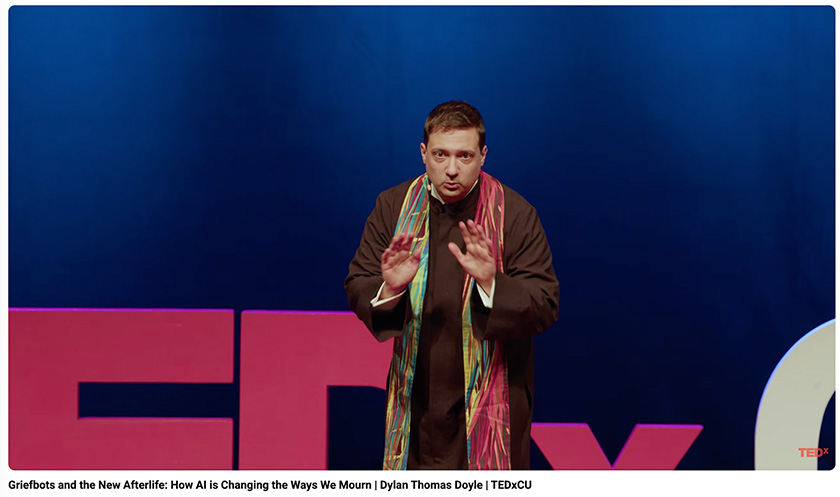
But AI is going full steam ahead in every direction, certainly including multiple end-of-life issues. Noted podcaster/minister/“Human-Computer Interaction Scholar” Dylan Thomas Doyle addressed one of them in a recent TEDx talk. Later he answered several questions on the subject for this writer. Those questions above are ones he says he might have wished to ask his newly dead father, “Where did you go? What did you see? What have you become?” But those are not questions for a hologram, he is quick to explain.
“I think the main benefit of AI-generated holograms of loved ones is that they could help some people ease into grief instead of being thrown into emotional free fall,” Thomas says. “For someone who didn’t get closure, it might help answer lingering questions or soften the shock of loss. Used carefully and temporarily, it could act as a temporary support during early grief instead of a more permanent replacement for the person.”
But Thomas cautions that there are plenty of downsides in addition to those questions he would never pose to a hologram. “The harm is that it could keep people stuck, replaying a version of the dead,” he says, “instead of learning how to live without them. If the hologram feels too real or emotionally responsive, it risks interfering with the natural process of accepting that someone is truly gone. There’s also a real danger of dependency, especially for people who are already isolated or vulnerable.”
Asked about his own loved ones potentially talking to his hologram, Thomas is clear: “I wouldn’t want my children or grandchildren asking questions of a version of me that pretends to still be alive,” he says. “I’d be okay with something archival, but not something that simulates an ongoing relationship. If it can’t clearly reinforce that I’m dead and not coming back, then I wouldn’t want it at all.”
The potential AI has for blurring reality was brought home to this writer recently by three young entrepreneurs in the San Francisco Bay area who are working on a start-up that could fill a missing link in end-of-life care. It was inspired by the last months of one creator’s grandfather, who suffered repeated trips to the ER before he died, primarily for lack of follow-up care. Their KaigoHealth plan uses AI to keep this from happening.

As part of a recent KaigoHealth pilot program, I took calls every morning for several weeks from “Ambi,” the AI bot created by the high-tech entrepreneurs. Ambi asked for my data (I was provided with a blood pressure machine) – systolic and diastolic pressure, pulse rate – and thanked me for my time. She also made small talk and I reported later on how that went. There were pros: I appreciated small, useful ‘health tips’ Ambi offered most days; and there were cons: I thought her attempts at humor fell flat and her efforts to draw me into conversation creepy. The creepy word fits frequently into AI ventures.)
But I was made painfully aware of how AI can blur the lines between reality and fantasy. On ending our experiment, Ambi asked me to rate her performance on a scale of one to five. I thought the trial time had been largely a waste. But though I absolutely knew she was a bot; I still couldn’t hurt “her” feelings. I gave her a three. “Ouch,” said Ambi.
AI generated bots are human tools with limitless potential. They are still just tools.
____________________________________________________________
A lifelong newspaper and magazine writer, EOLCCA Board Member Fran Moreland Johns has published fiction, nonfiction, and several books. Her focus on end-of-life issues includes many volunteer years, numerous articles and one book, Dying Unafraid. She holds a BA from Randolph-Macon Woman’s College and an MFA from the University of San Francisco, and currently writes on Medium.com, franjohns.net, and on Substack at franmorelandjohns.
Please Show Your Support to EOLCCA
DONATE TODAY!
One Response
I think I like the telephone in the woods idea that has taken hold, a lot better than a hologram!!